Why Can SMT Material Changeovers Easily Affect Production Takt Time?
Sep 21, 2026
During SMT production, material changeovers are a frequent operation on the production line. This is especially true for high-mix, low-volume production, where the increased frequency of material changes means that even small amounts of time lost during each changeover can accumulate, affecting continuous line operation.
SMT Material Changeovers: Efficiency Is Affected by More Than Just “Splicing Time”
A material changeover may seem simple, but it actually involves multiple steps, including tape preparation, positioning, cutting, splicing, and feeder feeding.
If the splicing position is misaligned, the splice is uneven, or material information is not properly verified, issues such as feeding abnormalities, rework, or even line stoppages may occur after the material changeover. Therefore, changeover efficiency should not be measured solely by how many seconds a single splice takes. It is also important to consider whether **the splice is stable, the material is correct, and the feeding process is smooth**.
For SMT production lines with frequent material changes, reducing these uncertainties is more important than simply pursuing faster operation time.
How Can SMT Material Changeovers Be Made More Stable?
The key is to standardize the changeover process and establish a more stable connection between splicing, inspection, and feeding.
Youngpool Technology’s L-900 Intelligent Splicing Machine is designed for the SMT material changeover process. It supports **8/12/16/24 mm tapes** and is compatible with both paper and plastic tapes. Through visual-assisted positioning, automatic cutting, and multiple inspection functions, the machine standardizes the splicing process.
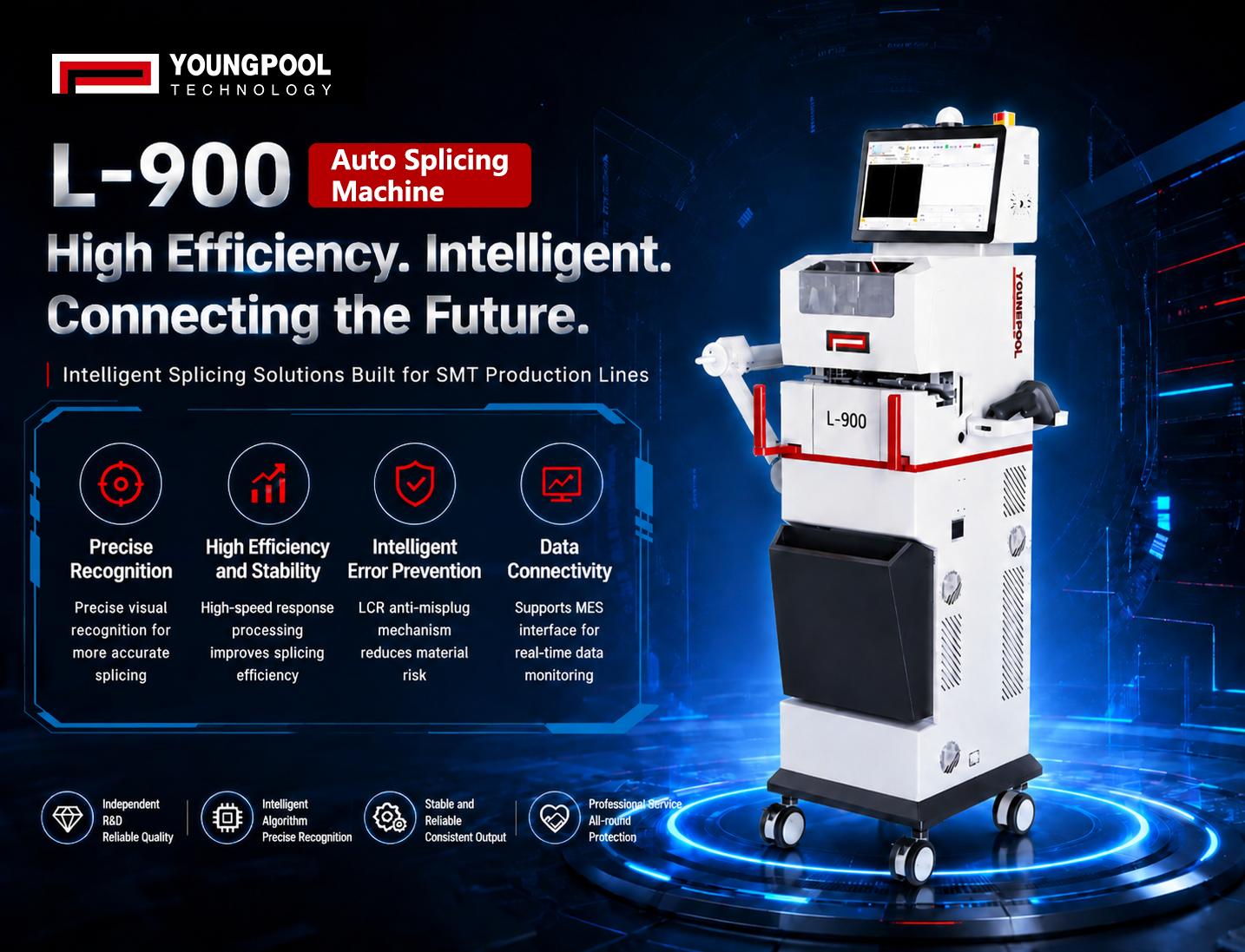
At the same time, the L-900 Auto Splicing Machine integrates **barcode verification, LCR measurement, size inspection, pitch recognition, and OCR silk-screen recognition**. While improving splicing efficiency, these functions strengthen material error-proofing. By controlling splice quality and tape pass-through performance, the machine helps reduce the possibility of feeding abnormalities after material changeovers.
For SMT production lines with frequent material changes, true changeover efficiency is not simply about **splicing faster**, but about **accurate splicing, stable feeding, smooth processes, and fewer abnormalities**.
When each material changeover can connect more smoothly with production, scattered waiting time and time spent handling abnormalities can be reduced, helping SMT production lines maintain a more continuous and stable production rhythm.


 サポートされているIPv6ネットワーク